Lucas Ray
A Dog's Way HomeLucas Ray is Bella’s person: the human whose presence makes her feel secure, whose absence unsettles her, and whose care extends beyond her to the feral cats across the street. He feeds the cats, tries to shield them from approaching machinery, and shares ordinary pleasures with Bella, from a morsel of chicken skin to hikes in the hills. His significance lies in the tension between that steadfast care and the limits he cannot overcome: he can offer protection and affection, but he cannot guarantee that Bella will remain beside him.
Identity and Introduction
Lucas introduces himself by name when Gunter Beckenbauer asks who he is. He explains that he lives across the street and sees the cats come and go, making clear that the colony is not an abstract concern to him but part of the neighborhood he inhabits. Gunter identifies himself in turn and briefly grips Lucas’s hand. When Lucas returns his hand to Bella, she detects the smell of meat and smoke on his skin. The exchange sets the human conflict around the cats against the small, intimate details of Lucas’s life with Bella; Gunter then asks whether Lucas has been rolling back his fence, which he says his workers have repaired three times. The evidence records the accusation and the introduction, but not Lucas’s answer to it.
Bella’s account makes the attachment between them the measure of safety. When Lucas is with her, the world seems wonderful; when he is gone, she feels exposed and frightened, and she waits for him to return and reassure her that he still loves her. His occasional sharp “No!” leaves her cowering until she believes his anger has passed. This is Bella’s interpretation rather than an account of Lucas’s intentions, and the difference matters: he is her source of security, while his ordinary corrections can become, to her, signs of possible rejection.
Care for Bella and the Cats
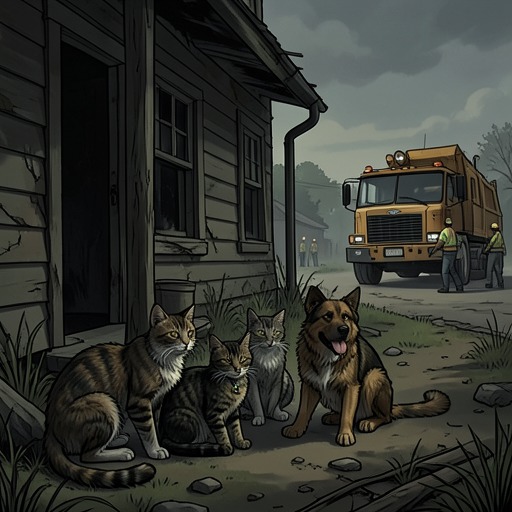
Feeding the cats is one of Lucas’s regular activities with Bella. He crosses the street and pushes through a flap in the fence, while Bella longs to follow him into the den. Instead, he ties her to a tree on the street side, keeping her from entering the cats’ refuge. By then Bella can smell three felines inside. Mother Cat stays out of sight, though the other two sometimes appear in the light. Lucas’s care therefore has two sides: he brings Bella along, but also keeps her at a distance from animals and a space she might disrupt or be unable to navigate safely.
Lucas speaks directly to the cats about the limits of his protection. He tells them he has a job and cannot be there all the time; he will try to protect them, but if the machines arrive, they will have to run away. At times he wriggles into the den, leaving Bella whimpering until he comes back. His warning recognizes that affection and vigilance cannot stop the machinery indefinitely. The scene also shows him trying to prepare the cats for flight rather than promising a rescue he may not be able to provide.
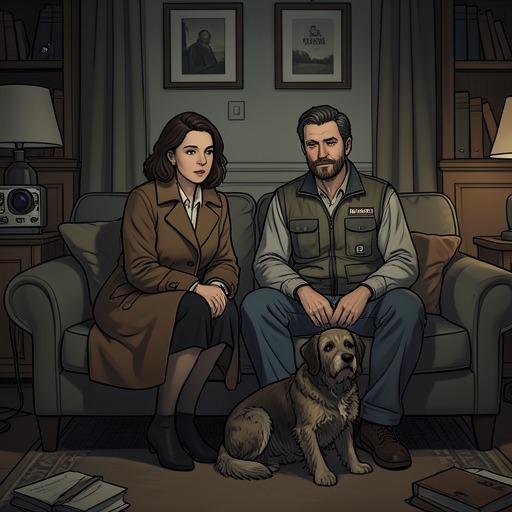
At home, Lucas and Terri eat chicken while Bella waits patiently for a share. Lucas gives her a tiny piece of skin from his fingers, a small act that becomes part of her understanding of him as a source of pleasure and comfort. He also discusses the cats’ numbers with Terri, estimating that there are at least three, perhaps four, though they are hard to count. His attention moves easily between Bella’s immediate needs and the colony’s uncertain circumstances.
Everyday Life and Emotional Support
Lucas’s care is not limited to moments of danger. As the weather warms, he goes hiking with Bella and Olivia in the hills. Bella recognizes the preparations: Lucas takes a strapped sack from his closet, and she associates it with treats. During one hike, Olivia spots a fox, and Lucas excitedly draws Bella’s attention to it. The outing places him in a more relaxed role, sharing the landscape and encouraging Bella’s curiosity rather than managing a crisis.
He is also attentive to what Bella can do for other people. At the hospital, a visiting dog is kept out of sight for a few hours despite concern that Dr. Gann might hear about her presence. Ty takes Bella on her leash through rooms where people sit in chairs, and she receives petting and food from patients and staff. Lucas is not the person who leads her into those rooms in the described scene, but his anxious question about Dr. Gann shows that the visit takes place within the hospital’s constraints. Bella’s welcome there contrasts with the absence of dogs elsewhere in the building: the people are glad to see her, and her calm presence becomes a form of comfort.
Lucas later looks up information on his phone and tells Terri that fifteen percent of dogs can sense seizures. Terri responds that Bella seemed to know what was happening, and Lucas praises Bella as an amazing dog. The exchange gives him a role in recognizing and naming Bella’s apparent ability, without suggesting that it has been formally trained or established as a medical diagnosis. His response is affectionate as well as observant: he treats what Bella has done as meaningful and worthy of praise.
Separation, Conflict, and Significance
Lucas’s bond with Bella is most sharply tested when he cannot keep her safe. As she is about to be taken from him, he bends over her and apologizes, saying he cannot protect her, that it is his fault, and that he loves her. When the man holding the stiff leash approaches, Lucas snaps that the leash is unnecessary. His words and anger reveal the difference between the protection he has tried to offer and the outcome now unfolding. The scene does not erase the care shown in quieter moments; it makes the limit of that care painfully explicit.
Across these episodes, Lucas is defined by recurring acts of attention: feeding Bella from his hand, watching the cat colony, warning the cats about the machines, preparing treats for hikes, and noticing Bella’s response to Terri’s seizure. Those gestures connect domestic affection to responsibilities that exceed the home. Yet the story does not present him as all-powerful. Work keeps him from the cats, machinery threatens their shelter, hospital rules make Bella’s visit precarious, and animal control eventually takes her beyond his reach. His apology at their separation gathers these pressures into a single moment: Lucas remains Bella’s source of love even when he cannot make that love a guarantee of safety.